
How I Use ChatGPT to Create Laser-Focused Avatars for Clients
A step-by-step guide with real prompts, real examples, and no fluff

“If you try to speak to everyone, you speak to no one.” – Meredith Hill

Most clients don’t know who they’re really writing for.
They might have a general idea—“agency owners,” or “HR professionals,” or “founders who want to grow”—but it’s vague. And when the audience is vague, the content that follows falls flat.
Posts don’t land.
Copy doesn’t convert.
Strategy drifts.
That’s why every time I start working with a client, I begin by helping them define their One True Fan (OTF)—a psychologically rich, data-informed avatar that becomes the North Star for every piece of content they create.
And yes, I build it with ChatGPT.
Why It Works
This isn’t a surface-level persona with fluffy goals and imaginary hobbies. It’s a structured, repeatable workflow I use for:
Writing high-performing LinkedIn content
Creating newsletters that convert
Building clear messaging for websites and YouTube scripts
It’s inspired by Kieran Drew’s High Impact Writing course (highly recommend if you publish online), and refined through client work over the past year.
Here’s what we’re going to build:
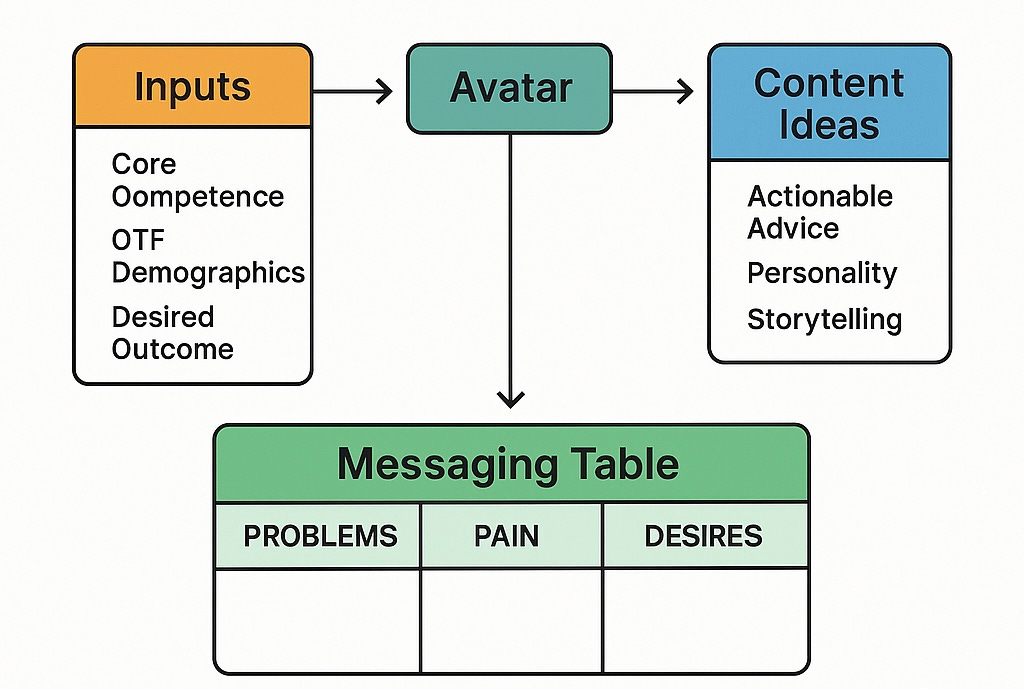
Phase 1: Lay the Foundation
Before touching an LLM (I use ChatGPT mainly for its memory function, but this process will work in any LLM), I collect four critical pieces of context from the client:
Core Competence – What’s the product or service uniquely great at?
OTF Demographics – Age, job title, industry, and seniority
Desired Outcome – What the customer really wants to achieve
Problems solved - How does the product make the customer’s life easier?
This acts as the input for every prompt that follows.
Phase 2: Build your avatar
Step 1 - Set the stage
You want to prep your LLM for what’s coming. I use this prompt
I am writing to attract an audience for my client’s product called [PRODUCT NAME]. You are an expert in understanding what motivates people. I want you to help define my ideal reader so I can create specific and emotionally resonating content for them. From now on, we will refer to my ideal reader as the ‘One True Fan’ (OTF).
Next, I will give you some information to plan this out.
1. My core competence (the value the product offers to the market)
2. My OTF’s demographics and desired end outcome
Ready?
Once your LLM has confirmed that it’s ready, you can get going
Step 2 - Add the details
Use the information that your client has provided in the spreadsheet (mentioned above) to give your LLM a starting point to work from:
The product’s core competence: [DESCRIPTION OF THE PRODUCT]
My OTF’s demographics:
Age: [INSERT TARGET AGE]
Sector: [INSERT TARGET SECTOR]
Job Level: [INSERT DETAILS ON SENIORITY OR JOB DESCRIPTION
Desired outcomes: [BULLETED LIST OF HOW THE PRODUCT WILL BENEFIT THEM]
Step 3 – Uncover Their Dreams
Now we get into the fun stuff:
Your first job is to help me find the deeper motivations behind their desired end outcome. We’ll call these dreams. We do this by asking ‘What does this mean to them?’. For example, making money is a surface-level desire. Security is a deeper dream.
Please give me 10 descriptions of the deeper dreams for my OTF. Give the list the title: My OTF’s Dreams (h2).
Help me find the deeper motivations behind their desired end outcome. We'll call these Dreams.
We do this by asking: “What does this mean to them?” (e.g. making money → financial security).
Give me 10 descriptions and label it: My OTF’s Dreams.
You’ll uncover hidden drivers like peace of mind, legacy, empowerment, or time for what matters—emotional fuel that helps content resonate beyond the surface level.
Step 4 – Define Measurable Desires
Now we move on to what they want day-to-day:
Next, I’d like you to help me identify the external desires attached to success. These are things that can be measured. Please give me 10 — keep it relevant to our OTF and my core competence. Give the list the title: MY OTF’s desires (h2).
You’ll get back a list of things that your target audience requires: perhaps higher revenue, fewer reporting errors, better stakeholder buy-in. These give you the KPIs that your content can speak to.
Step 5 – Identify their problems
Let’s find their problems. If we can talk to these issues specifically, then we can position our clients product as a potential solution to what’s keeping them up at night:
Next, I’d like you to help me find the problems they might experiencing (that I could potentially solve). Problems can be internal or external roadblocks. Please give me 10. Keep it relevant to our OTF and my core competence. Give the list the title: MY OTF’s problems (h2).
These might include data silos, overreliance on spreadsheets, or difficulty forecasting. Ideal for building problem-aware LinkedIn content.
Step 6 – Explore Emotional Pain
Let’s really dig into those problems. If we can find identify what’s really causing pain, then we can help:
I’d like you to find the deeper pain behind each problem. This is how it makes them feel, and will help me craft deeply resonating messages. Please give me 10. Keep it relevant to our OTF and my core competence. Give the list the title: MY OTF’s pain (h2).
Now you have real quotes to use in your posts:
“I’m constantly second-guessing myself.”
“I don’t know where the money’s coming from.”
“One mistake could ruin everything.”
You can use these ideas to stop your clients audience from doom scrolling social media and generate content which begins to build empathy.
Step 7 – Summarise in a Table
Right, we’ve got a lot of information already. Let’s pull it altogether in one place to make it easy to read.
Can you put this into a summary table for me?
4 columns. Problems. Pains. Desires. Dreams.
This table becomes your compass when planning content or writing hooks that connect emotionally and strategically.
Phase 3: Generate Content That Converts
Right, we’ve got a pretty good overview of our target audience, now. Now that we’ve built the avatar, let’s use it to generate content across three main categories—optimised for social media (I focus on LinkedIn) but flexible enough to adapt elsewhere.
We’re going to focus on three specific types of content that has been proven to best engage prospects at the top of the sales funnel.
Next, I would like you to help me think of potential content ideas based on the information provided.
We have 3 buckets of content:
1. Actionable advice → to overcome problems and achieve the desired end outcome
2. Personality → what we stand for, against, and what makes us different (to build a bond)
3. Storytelling → stories that can help inspire our OTF to take action, and share useful lessons
Bucket 1 – Actionable Advice
Prompt 1: Do’s:
I want to focus on actionable advice first.
First, list 50 ‘how to’ content ideas for what my OTF should do. Keep it relevant to my core competence. Give the list the title ‘Actionable advice - Do’s (h2):
You’ll get a list of potential ideas which would be perfect for:
Step-by-step posts
Value-packed carousels
Quick wins that showcase expertise
Prompt 2: Don’ts
After that:
Next, I’d like you to help me think of content ideas for what not to do. Please give 50 common things my OTF should avoid related to my core competence and their end desired goal. Title this list the title ‘Actionable Advice - Don’t (h2)”
These drive great engagement on LinkedIn by being punchy, contrarian, or emotionally charged.
Bucket 2 – Personality
Prompt 1: Strong Beliefs
Next, I’d like you to help me think of interesting personality ideas.
For reference. The best personality-based content goes against status quo (calling out common misconceptions, advice, and actions). It must be relevant to our OTF, and the best stuff is timely and on their mind.
Give me 20 strongly held beliefs that I could appeal to as related to my core competence. Title this list ‘Personality - Strong Beliefs (h2):
Prompt 2: Enemies
Just as it’s important to know what you stand for, it is also important to know what you’re against. Being able to highlight a common enemy can pull people towards you and get them to buy into your beliefs more strongly:
I’d like you to frame these 20 beliefs through the lens of an enemy. I don’t need you to name these, just give me interesting angles that I could use for my content. Title this list ‘Personality - Potential Enemies (h2).
You get lines like:
“The spreadsheet that holds your strategy hostage”
“The lack of buy in from senior leaders”
“The mindset that charities should make do with less”
Bucket 3: Storytelling
Social media loves story-driven content - being able to tell stories well will almost guarantee you a loyal and large following. So, once the emotional map is clear, lets extract relatable story prompts.
Based on the problems, pains, desires, and dreams of my OTF, give me 20 interesting storytelling angles that reflect their world and challenges. Title: Storytelling – 20 Interesting Angles.
Examples:
“Why our best sales person almost quit”
“The data error that nearly cost us a major funder”
“What happened when we visualised our data for the first time”
These bring the avatar to life and show transformation.
Phase 6: Build your Content Calendar
Having gone through the above, this is the pay off. Let’s use everything we have learned to identify the titles of potential social media posts
Prompt 1: Carousel Posts
Based on everything you’ve learned, suggest title for 20 LinkedIn posts that could involve a carousel. These tend to be step-by-step guides or listicles. For example
- 7 Myths about AI that need to be-debunked
- 6 pieces of AI software I used to build my business
Examples:
5 Numbers Every Fundraising Director Should Know
7 Mistakes SAAS Platforms Make With Their Monthly Reports
10 Red Flags That Your Data Can’t Be Trusted
Prompt 2: Entertaining Posts
We all like to be entertained and distracted from what’s worrying us so let’s identify some content that will entertain our prospects:
Now come up with titles for 20 LinkedIn posts that will entertain my OTF
You might get results like:
“If spreadsheets had feelings, mine would need therapy”
“Confessions of a Finance Director: I Pretended to Understand the Pivot Table”
“Forecasting? I Prefer the Ancient Art of Wild Guessing”
These posts build personality, relatability, and followers—fast.
What You End Up With
By the end, you’ll have:
A clear, human avatar of your One True Fan
A messaging matrix with problems, pain, desires, and dreams
100+ content ideas tailored to your offer
Dozens of post titles ready for LinkedIn, newsletters, or YouTube
A proven system for high-impact, emotionally intelligent writing
Why This Works
Most content is written for an audience that hasn’t been clearly defined.
This system fixes that.
It helps you write like you’re speaking to one person
It anchors your message in emotion, not fluff
It generates trust because it’s specific, empathetic, and clear
It’s how I win and keep clients. And it’s how you can stop doom-scrolling LinkedIn and start creating content that actually lands.
Try It Yourself
If you’re serious about getting better at content marketing, try this system with your own business.
Or if you want help building your One True Fan avatar, just reply and say “OTF me.”
I’ll know what you mean.
One last thing
This post represents a more in-depth and different type of content for this newsletter. If you found this post useful, please let me know by liking it or leaving a comment and I’ll create more.
Equally, I’m really trying to grow this audience so feel free to share this article with friends or colleagues who you think would find it useful!
Really helpful and works well.